Smoking Room Ventilation: What COTPA Requires and How It Is Built
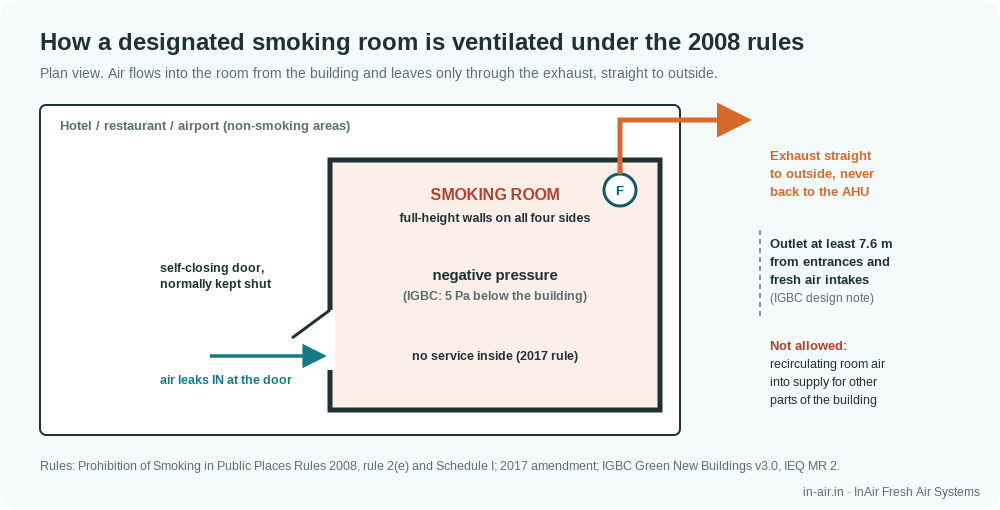
Under COTPA 2003, only hotels with thirty rooms, restaurants seating thirty or more, and airports may have a smoking area. It must be a room with full-height walls, a self-closing door and negative pressure, with its air exhausted straight outside and never recirculated. No service is allowed inside.
Who may have a smoking room in India
Smoking is banned in public places in India under section 4 of the Cigarettes and Other Tobacco Products Act, 2003 (COTPA). The proviso to that section allows a separate smoking area or space in a hotel with thirty rooms, a restaurant seating thirty or more people, and airports[1]. The Prohibition of Smoking in Public Places Rules, 2008 say how that space must be built[2].
- The rules count work places, shopping malls and cinema halls as public places, and the proviso names only hotels, restaurants and airports[1][2]. If you run any other kind of building, ask your legal adviser before planning a smoking room.
- The smoking area may not be at the entrance or exit of the hotel, restaurant or airport, and must be marked "Smoking Area" in English and one Indian language[2].
- No service of any kind is allowed in the smoking area. A 60 × 30 cm board at its entrance must say that smoking harms smokers and non-smokers and that people under 18 may not enter[3].
- A hotel with thirty or more rooms may also set aside smoking guest rooms, grouped on one floor or wing, with smoke ventilated outside so it does not reach lobbies and corridors[2].
What the rules mean for the ventilation
Rule 2(e) of the 2008 rules defines a smoking area as a separately ventilated smoking room. Each condition has a direct ventilation consequence[2].
| Rule 2(e) / Schedule I | What it means in practice | What InAir checks |
|---|---|---|
| Physically separated, full-height walls on all four sides | Walls run slab to slab, not just to the false ceiling. Gaps above the ceiling let smoke travel. | Wall height above the ceiling, service penetrations, shafts |
| Entrance with an automatically closing door, normally kept closed | A door closer, and a door that seals well enough to hold the pressure difference | Door closer, undercut or transfer grille size |
| Air flow system as in Schedule I | Air is exhausted directly to outside and not mixed back into supply air for other parts of the building | Exhaust route to outside, distance to intakes and windows |
| Negative air pressure compared with the rest of the building | The exhaust takes out more air than enters by any route except leakage from the building, so air flows into the room, not out | Supply air in the room, AC type, balance against exhaust |
| Hotel smoking rooms: smoke ventilated outside | Each room's bathroom or room exhaust goes outside and the corridor stays smoke-free | Exhaust risers, corridor pressure |
Negative pressure: how it is achieved
A room is at negative pressure when more air is taken out of it than is supplied to it. The difference is made up by air leaking in from the rest of the building, through the door gaps and any transfer grille. Smoke then has no path out except the exhaust.
- IGBC's Green New Buildings rating asks for a completely sealed smoking room held at 5 Pa below the building, with all air from the room exhausted and none returned to the air handling units. The exhaust louvre or duct must be at least 7.6 m from building entries and fresh air intakes[4].
- Any AC in the room should be a unit that only cools the room's own air, such as a split unit, or a supply that is less than the exhaust. A central AHU return grille in the smoking room breaks the rule.
- Bigger rooms need more exhaust, but the code text we checked gives no fixed airflow for smoking rooms. InAir sizes the exhaust to hold the pressure difference with the door shut and to clear smoke quickly, then proves it with a pressure reading at handover.
- NBC's air change table notes that rates may be raised by 50% where heavy smoking occurs, for non-air-conditioned spaces[5].
What ventilation cannot do
A well-built smoking room keeps smoke out of the rest of the building. It does not make the air inside the smoking room safe. The WHO states that there is no safe level of exposure to second-hand tobacco smoke[6]. The US CDC summarises ASHRAE's 2010 position that the only way to effectively eliminate the health risks of indoor exposure is to ban smoking indoors, and notes that even separately exhausted, negative-pressure rooms can let smoke spill into adjacent areas[7].
That is why InAir does not describe a smoking room as healthy or safe, and why a smoke-free building, or an outdoor smoking area away from doors and air intakes, is the better choice where the business allows it. IGBC accepts an outdoor smoking area at least 7.6 m from all air intakes, entrance doors and windows[4].
Recommended InAir equipment
| Need | InAir solution |
|---|---|
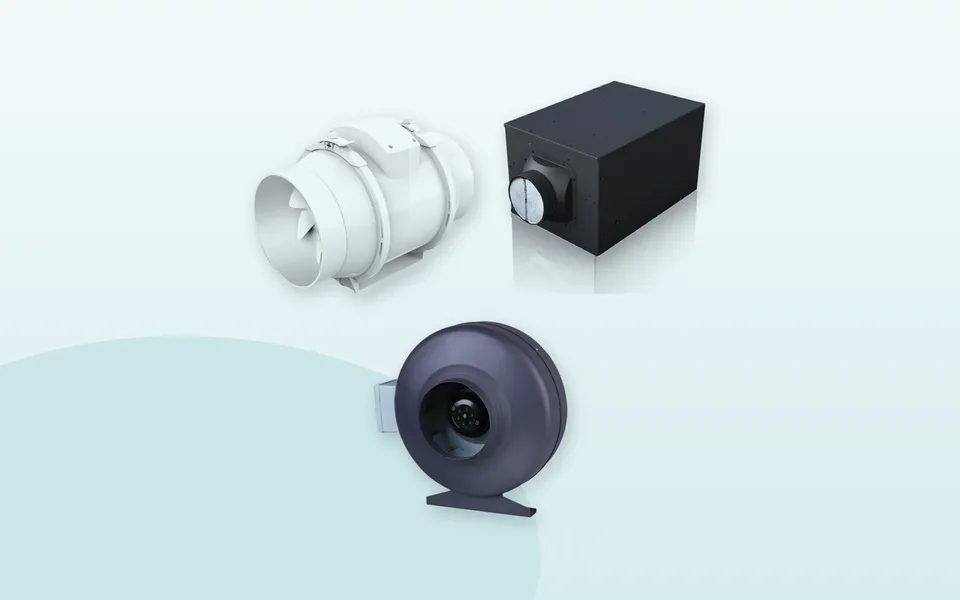
| Exhaust for a small smoking room or hotel smoking rooms | Mixed flow inline fans or EC inline duct fans with speed control, ducted to outside |
| Exhaust for a large airport or hotel smoking lounge | Cabinet centrifugal fans |
| Outlet to outside | Outdoor cowls and grilles, placed away from intakes and windows |
| Fresh air for the rest of the building | Revita / Ventura ERV, kept completely separate from the smoking room exhaust |
InAir does not connect a smoking room's exhaust to an ERV or any unit that also supplies air to other rooms. Schedule I asks for exhaust direct to outside, and keeping it on its own fan and duct removes any chance of transfer[2].
How InAir checks this at the site survey
- Eligibility and location. Whether the premises can have a smoking area under COTPA (30 rooms, 30 seats or an airport), and that the room is not at an entrance or exit.
- Walls, ceiling and door. Full-height walls to the slab, sealed service openings, and a self-closing door.
- Existing AC and ducts. Whether any central AC supply or return serves the room, and how to isolate it.
- Exhaust route. Where a duct can reach outside, and that the outlet is well away from windows, doors and fresh air intakes.
- Proposal and handover. Fan selection, a measured pressure difference across the closed door, and smoke-pencil checks at the door at commissioning.
What it costs
The cost depends mainly on the duct route to outside. Published starting prices for the fans are: mixed flow inline fans from ₹6,600, EC inline duct fans with speed control from ₹15,000, and cabinet centrifugal fans from ₹47,400, before GST and installation.
Tentative pricing: actual prices may vary based on the site survey.
Common mistakes
- A partition that stops at the false ceiling, so smoke drifts over it into the next room.
- A central AC return grille inside the smoking room, which sends smoke round the building.
- An exhaust outlet next to a fresh air intake, a window or the entrance.
- A door that is propped open or has no closer.
- Serving food or drinks inside the smoking area, which the 2017 amendment forbids[3].
- Relying on an air purifier or ioniser instead of exhaust to outside.
Frequently asked questions
Is a smoking room legal in India?
What are the ventilation rules for a smoking room?
Can an office have a smoking room?
How much negative pressure does a smoking room need?
Can food or drinks be served in a smoking room?
Does a smoking room protect staff and other guests?
References
- The Cigarettes and Other Tobacco Products (Prohibition of Advertisement and Regulation of Trade and Commerce, Production, Supply and Distribution) Act, 2003, section 4 and proviso; section 21 (Ministry of Health and Family Welfare, NTCP). https://ntcp.mohfw.gov.in/assets/document/Acts-Rules-Regulations/COTPA-2003-English-Version.pdf
- The Prohibition of Smoking in Public Places Rules, 2008 (G.S.R. 417(E), 30 May 2008), rules 2(e), 3 and 4 and Schedule I (text copy). https://www.rfhha.org/images/law/8.31%20Prohibition%20of%20smoking%20in%20public%20places%20Rules.pdf
- Prohibition of Smoking in Public Places (Amendment) Rules, 2017, G.S.R. 500(E), 23 May 2017. https://ntcp.mohfw.gov.in/assets/document/Acts-Rules-Regulations/GSR-500(E).pdf
- Indian Green Building Council, IGBC Green New Buildings Rating System v3.0 (with Fifth Addendum), IEQ Mandatory Requirement 2, Tobacco Smoke Control. https://d1owjfc1d3lv0e.cloudfront.net/website-assets/frontend-assets/html_pdfs/IGBC_Green_New_Buildings_Rating_System_(Version_3.0_with_Fifth_Addendum).pdf
- Bureau of Indian Standards, National Building Code of India, Part 8, Section 3, air change table and note (SP 7 Group 4, 2005 edition, Public.Resource.Org copy). https://archive.org/details/gov.in.is.sp.7.4.2005
- World Health Organization, Tobacco fact sheet. https://www.who.int/news-room/fact-sheets/detail/tobacco
- US CDC (archived), Ventilation does not effectively protect nonsmokers from secondhand smoke. https://archive.cdc.gov/www_cdc_gov/tobacco/secondhand-smoke/protection/ventilation.htm
- Official gazette copy of G.S.R. 417(E), Ministry of Health and Family Welfare, NTCP. https://ntcp.mohfw.gov.in/assets/document/Acts-Rules-Regulations/GSR-417(E).pdf
Book a free site survey
An InAir engineer will survey your space, size the fresh air and exhaust, and send a written proposal. Available across 15 Indian cities.