Basement Ventilation for Car Parks, Homes and Buildings
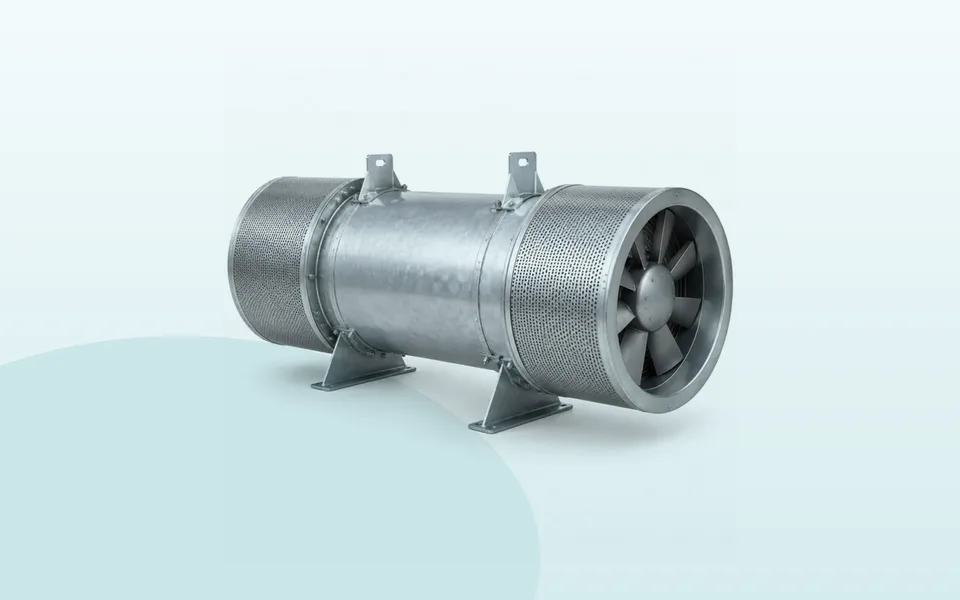
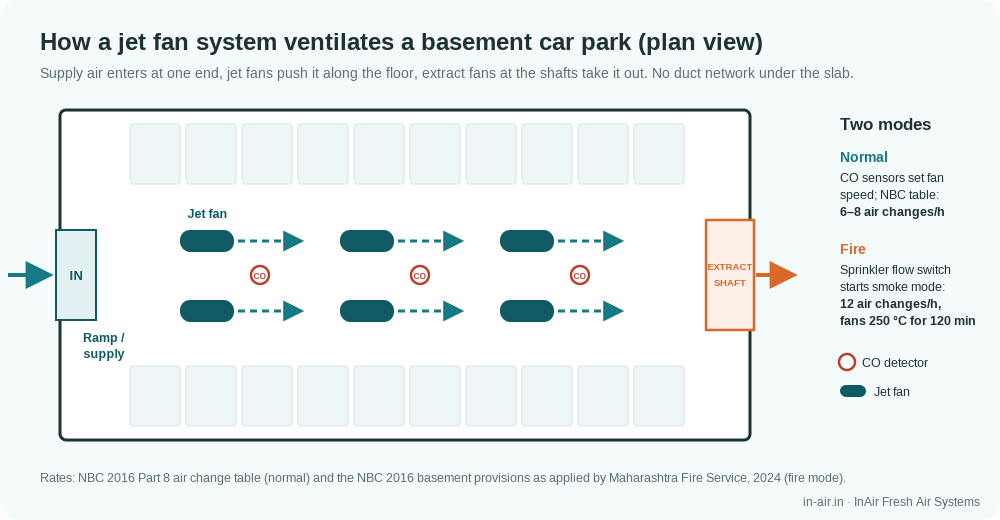
A basement needs mechanical exhaust and a planned path for replacement air. NBC's air change table gives 3–10 air changes an hour for basements and 6–8 for garages in normal use, and a basement car park's fire mode must reach 12. Jet fans move the air without ducts, controlled by CO detectors.
What a basement needs from its ventilation
A basement has no windows and sits below the outside air, so nothing moves unless a fan moves it. What the fans must do depends on what the basement is used for.
Car parks: fumes in normal use, smoke in a fire
Cars give off carbon monoxide and other exhaust gases every time they start, queue and climb the ramp. The ventilation dilutes these and carries them out. If a car catches fire, the same system has to clear smoke so people can get out and firefighters can get in. Indian fire rules treat this smoke mode as the harder of the two duties[2].
Home and building basements: damp and stale air
Basement rooms used as home theatres, gyms, stores or offices have a different problem. Walls in contact with the ground stay cool, and humid outdoor air that leaks in during the monsoon can condense on them. The US EPA advises keeping indoor humidity below 60%, ideally 30–50%, to limit mould[6]. People in these rooms also need fresh air, the same as in any other room.
Plant rooms and service basements
Pump rooms, DG rooms and electrical rooms need heat taken out and must not share air with the car park in a fire. These are designed with the building's MEP consultant, and InAir supplies the fans.
What the codes say
In India, the normal-running rate comes from the air change table in NBC 2016 Part 8, and the fire-mode rules come from the basement provisions used by fire authorities. The Maharashtra Fire Service set these out in a 2024 circular that applies NBC 2016 to parking structures[2]. Your local fire authority's conditions take priority, so InAir confirms them with your fire consultant before sizing anything.
| Item | Requirement | Source |
|---|---|---|
| Basements and cellars (general use) | 3–10 air changes per hour | NBC air change table[1] |
| Garages | 6–8 air changes per hour | NBC air change table[1] |
| Basement car park, natural ventilation | Vents of at least 2.5% of the floor area, spread round the perimeter (grilles, stall-board or pavement lights, or shafts) | NBC 2016 basement provisions[2] |
| Basement car park, mechanical ventilation, fire | 12 air changes per hour on a fire or distress call; normal running as per NBC Part 8, Section 3 | NBC 2016 basement provisions[2] |
| Each basement level | Ventilated separately; in multi-level basements, independent intake and smoke exhaust shafts per level, or common masonry shafts with back-draft dampers | NBC 2016 basement provisions[2] |
| Smoke exhaust fans and jet fans | Fire rated for 250 °C for 120 minutes; power panels in a fire-safe zone; fire-survival cabling to IS 16246 | NBC 2016 basement provisions[2] |
| Start-up in a fire | On the sprinkler flow switch, with local or remote manual control for firefighters and a visual status display | NBC 2016 basement provisions[2] |
How much air is that? A worked example
Take a single-level basement car park of 2,000 m² with a clear height of 3.0 m. Its volume is 6,000 m³. These are our own calculations from the rates above.
| Duty | Rate | Airflow |
|---|---|---|
| Normal running (garage rate) | 6–8 air changes per hour | 36,000–48,000 m³/h |
| Fire mode | 12 air changes per hour | 72,000 m³/h |
| Natural ventilation instead | Vents ≥ 2.5% of floor area | 50 m² of open vents round the perimeter |
The fire-mode airflow is far higher than normal running, so the extract fans are sized for fire mode and run at reduced speed most of the day. Carbon monoxide detectors decide how fast they run. For the full design method, see our guide to basement car park ventilation with jet fans.
Jet fans or ducted extract?
| Ducted extract | Jet fans (impulse ventilation) | |
|---|---|---|
| How air moves | Drawn into grilles on a duct network under the slab | Free-hanging fans push air along the floor to the extract shafts |
| Ceiling space | Ducts take depth and clash with beams, sprinklers and cable trays | Fans fix to the slab; beams and down-stands must be allowed for in the layout[2] |
| Smoke control | Through the same ducts and fans | Allowed by NBC-based rules as an alternative to ducts, if fans meet the fire rating[2] |
| Checking the layout | Duct pressure calculations | Usually a CFD model for both CO dilution and smoke clearance |
InAir jet fans come in one-way and reversible versions. Reversible models reach rated speed forward or reverse within 30 seconds, with Class H motor insulation and IP55 protection[7]. At selection we confirm that the chosen model carries the 250 °C, 120-minute rating your fire NOC needs, on its datasheet, before it goes into the drawings.
CO monitoring and fan control
Car parks are busy at office hours and nearly empty at night. Running the extract at fire-mode speed all day wastes power. Carbon monoxide detectors spread across each zone let the fans idle when the air is clean and speed up when queues build.
- The CO set-points are set by the MEP or fire consultant for the project. The codes we checked do not give one number for Indian car parks.
- For reference, GRIHA uses a limit of under 9 ppm of CO for occupied indoor spaces, taken from ISHRAE Standard 10001:2016[3]. India's outdoor air standard for CO is 2 mg/m³ over 8 hours and 4 mg/m³ over 1 hour[4].
- CO detectors for car parks are separate devices wired to the jet fan panel. InAir's IAQ sensor measures PM2.5, temperature, humidity and VOCs, not CO.
- Fire mode overrides CO control. The sprinkler flow switch starts smoke extraction whatever the CO reading[2].
Basements in homes and buildings
A basement room that people use needs two things: a supply of filtered outdoor air and a way to keep humidity down.
| Basement use | Main problem | What InAir fits |
|---|---|---|
| Home theatre, gym, office | Stale air, CO₂ build-up when the door is shut | ERV supplying filtered fresh air and extracting stale air |
| Store room, wine room, archive | Musty smell, damp walls in the monsoon | Fresh air dehumidifier or a dehumidifier with a small fresh air supply |
| Toilets and utility below ground | Odour and moisture | Inline extract fans ducted to outside |
| Lift lobby, corridors | Car park air drifting in | Kept at slightly higher pressure than the car park; lobby pressurisation is set by the fire consultant |
For room-by-room rates, the air changes calculator turns NBC rates into fan sizes. For damp, see monsoon humidity and fresh air dehumidification.
How InAir checks this at the site survey
- Use and layout. Car park, home basement or mixed use; floor area, clear height, ramps, beams and down-stands, and where the shafts are.
- The fire brief. We take the fire consultant's or fire authority's conditions (fire mode rate, compartments, shafts) as the starting point, not our own guess.
- Supply path. Where replacement air comes from: ramps, intake shafts or supply fans. Extract without supply does not work.
- Control points. Where CO detectors, the fire alarm interface and the manual firefighter switch will sit.
- Damp and fresh air (occupied basements). Humidity readings, signs of condensation, how many people use the space and for how long.
- Proposal. Fan selections, layout for CFD checking where needed, and a written quote.
What it costs
InAir quotes jet fans and car park systems after a free site survey, because the number of fans depends on the layout and the fire brief. For smaller basement duties, published starting prices are: mixed flow inline fans from ₹6,600, cabinet centrifugal fans from ₹47,400, and Revita ERVs from ₹2.1 lakh, before GST and installation.
Tentative pricing: actual prices may vary based on the site survey.
Common mistakes
- Sizing car park fans for normal running only. Fire mode at 12 air changes per hour sets the fan size[2].
- Extract fans with no planned supply path. The fans then pull air through lift lobbies and stairwells instead of the ramp.
- Jet fan rows placed without checking beams, ramps and down-stands, leaving dead zones where fumes and smoke sit.
- Using non-fire-rated fans or ordinary cabling on smoke duty.
- Running fans flat-out all day with no CO control.
- Bringing humid outdoor air into a home basement in the monsoon without drying it.
Frequently asked questions
How many air changes does a basement car park need?
Is natural ventilation allowed for a basement car park?
Can jet fans replace ducts in a basement?
Do car park fans need to run all day?
How do I stop a home basement smelling damp?
What does basement ventilation cost?
References
- Bureau of Indian Standards, National Building Code of India, Part 8 Building Services, Section 3: recommended air changes per hour (Table 5 in SP 7 Group 4, 2005 edition, Public.Resource.Org copy). https://archive.org/details/gov.in.is.sp.7.4.2005
- Directorate of Maharashtra Fire Service, Circular MFS/51/2024/1140 (18 July 2024), Guidelines for fire safety of parking structures, section 5 Basements, applying NBC 2016. https://mahafireservice.gov.in/circular/Guidelines%20of%20Parking.pdf
- GRIHA Version 6.0 (September 2025), Criterion 12, Table 12.2c: CO threshold from ISHRAE Standard 10001:2016. https://www.grihaindia.org/sites/default/files/2026-01/GRIHA-Version-6-V1_1%20%281%29.pdf
- Central Pollution Control Board, National Ambient Air Quality Standards (carbon monoxide). https://cpcb.nic.in/national-ambient-air-quality-standards/
- InAir, basement car park ventilation with jet fans. https://www.in-air.in/blog/car-park-jet-fan-design/
- US EPA, A Brief Guide to Mold, Moisture and Your Home. https://www.epa.gov/mold/brief-guide-mold-moisture-and-your-home
- InAir jet fans for basements, car parks and tunnels (product page). https://www.in-air.in/products/jet-fans/
Book a free site survey
An InAir engineer will survey your space, size the fresh air and exhaust, and send a written proposal. Available across 15 Indian cities.