Fresh air for kids' rooms: what parents should know
Parents' questions about a child's bedroom, answered from WHO guidance and peer-reviewed studies: airflow, filters, damp, paint smells and night-time noise.
Last updated:
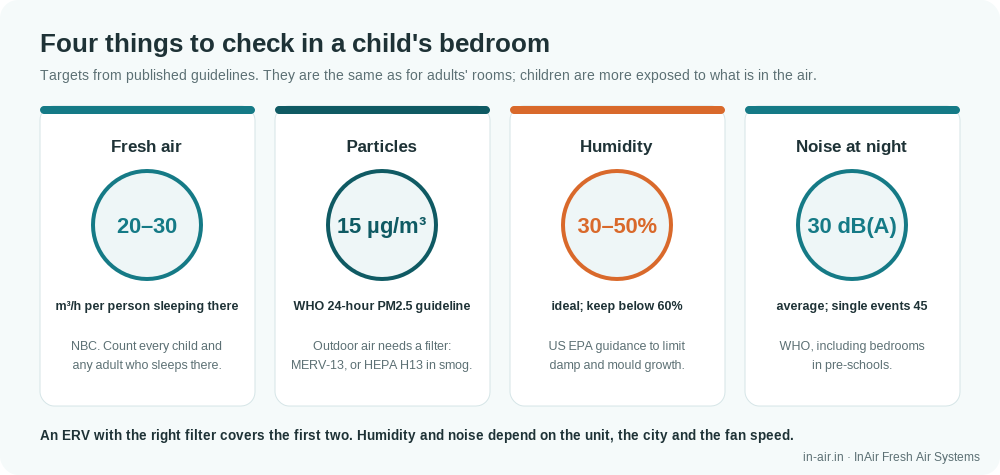
A child's room needs what any bedroom needs: steady fresh air for everyone who sleeps there (20–30 m³/h per person under India's building code), a good filter on that air, humidity kept below 60%, and a quiet machine at night. The WHO says children breathe more rapidly than adults and so take in more pollution, which makes the filter matter more.
Key points
- Count heads, not square feet. Two siblings, or a parent sleeping with a toddler, need twice the fresh air of one child.
- The WHO notes children breathe more rapidly than adults and so absorb more pollutants, and they live closer to the ground, where some pollutants peak.
- Outdoor air must be filtered. In winter 2024–25, average PM2.5 in Delhi was 175 µg/m³ (CSE), against a WHO 24-hour guideline of 15.
- Keep humidity below 60%, ideally 30–50% (US EPA). A WHO review links persistent damp and mould indoors with more respiratory symptoms, allergies and asthma.
- Fresh air is not a medical treatment. If your child has asthma or allergies, follow your doctor's advice; ventilation is one part of a healthy room.
Why do children's rooms need more care?
Parents ask this first, so here is what the evidence says, and no more. In its 2018 report Air pollution and child health: prescribing clean air, the WHO gives two reasons children are more vulnerable. They breathe more rapidly than adults and so absorb more pollutants. And they live closer to the ground, where some pollutants reach peak concentrations, while their brains and bodies are still developing. WHO also estimates that 93% of the world's children live where air pollution is above its guideline levels.
A child's bedroom is also where they spend the longest unbroken stretch of the day, often with the door and window shut for the AC or the mosquitoes. Whatever is in that room's air, they breathe all night. Our guide to indoor air with the windows closed explains where that air comes from.
How much fresh air does a child's room need?
India's National Building Code asks for 20–30 m³/h of fresh air per person. On CO₂ arithmetic, about 21 m³/h per adult holds a room near 1,000 ppm. Children breathe out less CO₂ than adults, because CO₂ output follows body size and activity (Persily and de Jonge, 2017). So using the adult rate for each child gives a margin rather than a shortfall.
| Who sleeps in the room | People | NBC 20–30 m³/h each | CO₂ basis, adult rate |
|---|---|---|---|
| One child | 1 | 20–30 m³/h | about 21 m³/h |
| Two siblings sharing | 2 | 40–60 m³/h | about 42 m³/h |
| Parent and young child | 2 | 40–60 m³/h | about 42 m³/h |
| Three children sharing | 3 | 60–90 m³/h | about 63 m³/h |
Rooms change as children grow: a cot becomes a bunk bed, a grandparent moves in. Size for the most people who will sleep there. The bedroom CO₂ calculator shows how quickly a closed room fills up, and CO₂ levels explained covers what the numbers mean.
Does fresh air help children concentrate?
Most of the research is from classrooms, not bedrooms, and it is about performance, not health. A 2020 review by Wargocki and colleagues in Building and Environment pooled published classroom studies. It predicted that lowering CO₂ from 2,100 ppm to 900 ppm would make psychological tests and school tasks about 12% faster, with about 2% fewer errors. It also found benefits as ventilation rose from 2 to 10 litres per second per pupil, with no data above that.
That is a reason to keep a homework corner well ventilated, not a promise of better marks. The same applies to sleep: small studies in adults found deeper sleep when bedroom CO₂ was lower; see bedroom CO₂ and sleep. We found no equivalent study in Indian children's bedrooms.
Dust and smog: which filter for a child's room?
Bringing outdoor air in only helps if it is cleaner than the air it replaces. Winter PM2.5 in 2024–25 averaged 175 µg/m³ in Delhi, 65 in Kolkata, 52 in Hyderabad, 50 in Mumbai, 37 in Bengaluru and 36 in Chennai (CSE analysis of CPCB data). India's own 24-hour standard is 60 µg/m³; the WHO guideline is 15.
| Filter | What it catches (test standard) | When parents choose it |
|---|---|---|
| Pre-filter | Coarse dust, lint, insects | Always, to protect the main filter and core |
| MERV-13 | At least 85% of 1–3 µm particles (ASHRAE 52.2) | Most Indian cities for most of the year |
| HEPA H13 | At least 99.95% at the most penetrating particle size (EN 1822) | Delhi NCR winters, homes near busy roads or construction |
An air purifier in the room helps with dust that is already inside. It does not bring in outdoor air, so it cannot lower CO₂. Many families use both: see air purifier or fresh air system.
Damp, mould and humidity
Children's rooms often have cupboards full of clothes and soft toys against outside walls. In the monsoon, and in coastal cities all year, these are where mould starts. The WHO's guidelines on dampness and mould (2009) review the evidence and link persistent indoor damp and mould with more respiratory symptoms, allergies and asthma. Their main advice is to prevent persistent damp and mould growth in the first place.
The US EPA advises keeping indoor humidity below 60%, ideally 30–50%. A cheap hygrometer tells you where your child's room stands. An ERV with an enthalpy core passes part of the moisture in incoming air to the outgoing stream, so it adds less humidity than a fan that blows outdoor air straight in. In very humid cities, it may need help from the AC's dry mode or a dehumidifier; see monsoon humidity and fresh air.
New furniture, paint and cleaning sprays
A new nursery is often freshly painted and furnished. The US EPA says concentrations of many VOCs (volatile organic compounds) are consistently higher indoors than outdoors, up to ten times higher, and lists paints, varnishes, cleaners, aerosol sprays and air fresheners among the sources. Its first step to reduce exposure is to increase ventilation when using such products. Steady fresh air dilutes what these products give off; it does not remove the source, so airing a newly painted room before a child sleeps in it still makes sense.
Is it safe and quiet enough to run all night?
The WHO's Guidelines for Community Noise (1999) give 30 dB(A) as the average level for sleep inside bedrooms, and the same 30 dB(A) for bedrooms in pre-schools during sleeping time, with single noise events below 45 dB(A). That is the target for the room, not the number on the machine.
- A ducted ERV keeps the fan above a false ceiling outside the child's room; only a grille is in the room.
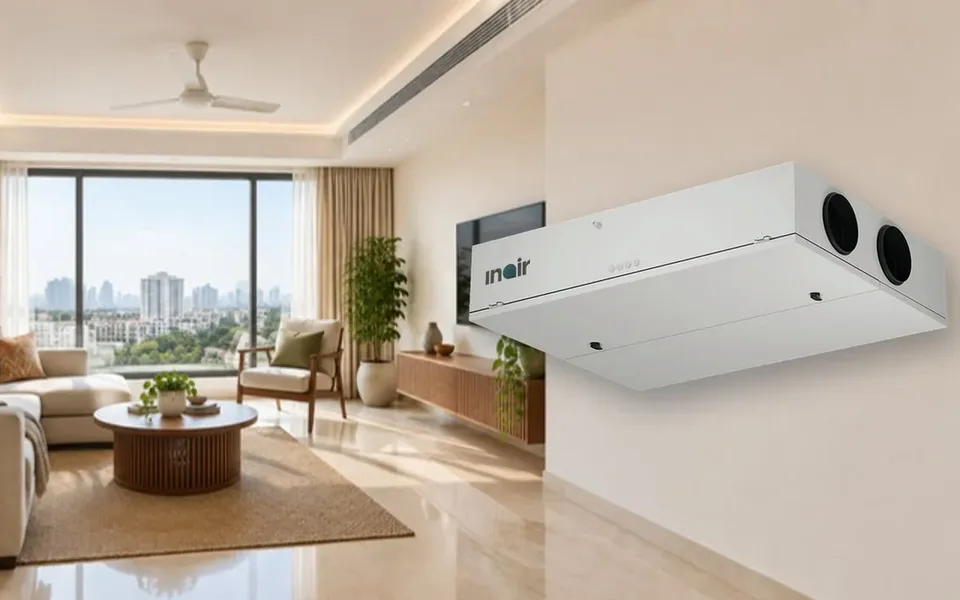
- A wall-mounted ERV is inside the room. InAir's INA-WERVG20-150CMH is listed at 35 dB; ask to hear it on the speed it will run at night.
- Air should not blow straight onto a cot or bed. Where grilles go is part of the survey.
- InAir's IAQ sensor shows PM2.5, temperature, humidity and VOCs. It does not measure CO₂; for that, use a separate NDIR CO₂ monitor. See the air quality monitor guide.
Which InAir units suit a child's room?
| Wall-mounted ERV INA-WERVG20-150CMH | Revita ducted ERV (INA-MFQR) | |
|---|---|---|
| Serves | One room or zone of 250–350 sq ft | Every room in the home from one unit; INA-MFQR-150 suits a 1 BHK, larger models bigger homes |
| Airflow | Up to 150 m³/h | 150–1,317 m³/h across the range |
| Energy recovery | 3D enthalpy core rated at 92% | Plate core, 89–90% heat recovery (tested) |
| Filters | Three-stage plus charcoal | Pre-filter and MERV-13; HEPA-13 optional |
| Noise (spec sheet) | 35 dB | 35 dB(A) at full flow for INA-MFQR-150; see each spec sheet |
| Installation | Core-cut through an outside wall | False ceiling and ducts |
If only the children's room needs fresh air, the wall unit is simpler. If several bedrooms do, one Revita ERV serves them all. Specs: INA-WERVG20-150CMH. For an adults' room, see which fresh air machine for a bedroom.
How InAir checks this at the site survey
- Who sleeps in each room now and in the next few years, to set the airflow.
- Your city's winter PM2.5, to choose MERV-13 or HEPA-13.
- Humidity in the room and signs of damp behind cupboards and on outside walls.
- Where a wall unit or grille can go so air does not blow on the bed, and whether a wall unit is within a child's reach.
- The speed the unit will run at night, and how that sounds in the room.
- CO₂, humidity and PM2.5 readings with the door and windows shut, before and after.
What it costs
InAir's wall-mounted ERV for one room starts from ₹1.4 lakh per unit. A Revita ducted ERV for a 1–2 BHK starts from ₹2.1 lakh, and for a 3–4 BHK from ₹2.6 lakh. Prices are for equipment before GST; installation is quoted after the survey. See the price guide.
Tentative pricing: actual prices may vary based on the site survey.
Common mistakes and myths
- "An air purifier is enough." It cleans particles but adds no fresh air, so CO₂ still rises with the door shut.
- "Open the window and the room is fine." In a smoggy winter that brings unfiltered PM2.5 straight in.
- Sizing for one child when two siblings or a parent also sleep there.
- Ignoring damp behind wardrobes on outside walls during the monsoon.
- Expecting ventilation to treat an illness. It improves the air in the room; medical questions belong with your child's doctor.
Sources
- WHO news release, More than 90% of the world's children breathe toxic air every day (29 October 2018). who.int
- WHO Guidelines for Indoor Air Quality: Dampness and Mould (2009). who.int
- WHO Guidelines for Community Noise (1999), Table 1. who.int
- Wargocki P, Porras-Salazar JA, Contreras-Espinoza S, Bahnfleth W. The relationships between classroom air quality and children's performance in school. Building and Environment 2020;173:106749. doi.org/10.1016/j.buildenv.2020.106749
- Persily A, de Jonge L. Carbon dioxide generation rates for building occupants. Indoor Air 2017. doi.org/10.1111/ina.12383
- US EPA, Volatile organic compounds' impact on indoor air quality, and A brief guide to mold, moisture and your home. epa.gov (VOCs) and epa.gov (mould)
- Centre for Science and Environment, winter 2024–25 air pollution analysis for six megacities. cseindia.org
- Bureau of Indian Standards, National Building Code of India, Part 8 Section 1, clause 5.2.2 (SP 7:2005 Group 4). archive.org
Is a fresh air system safe for a baby's or child's room?
How much fresh air does a child's bedroom need?
Is an air purifier enough for my child's room?
Which filter is best for a kids' room in Delhi?
Can fresh air help with my child's asthma or allergies?
What does a fresh air system for a kids' room cost?
Our engineers assess your home or building, recommend the right system and the right filter grade for your city, and give you a clear cost estimate. No obligation.